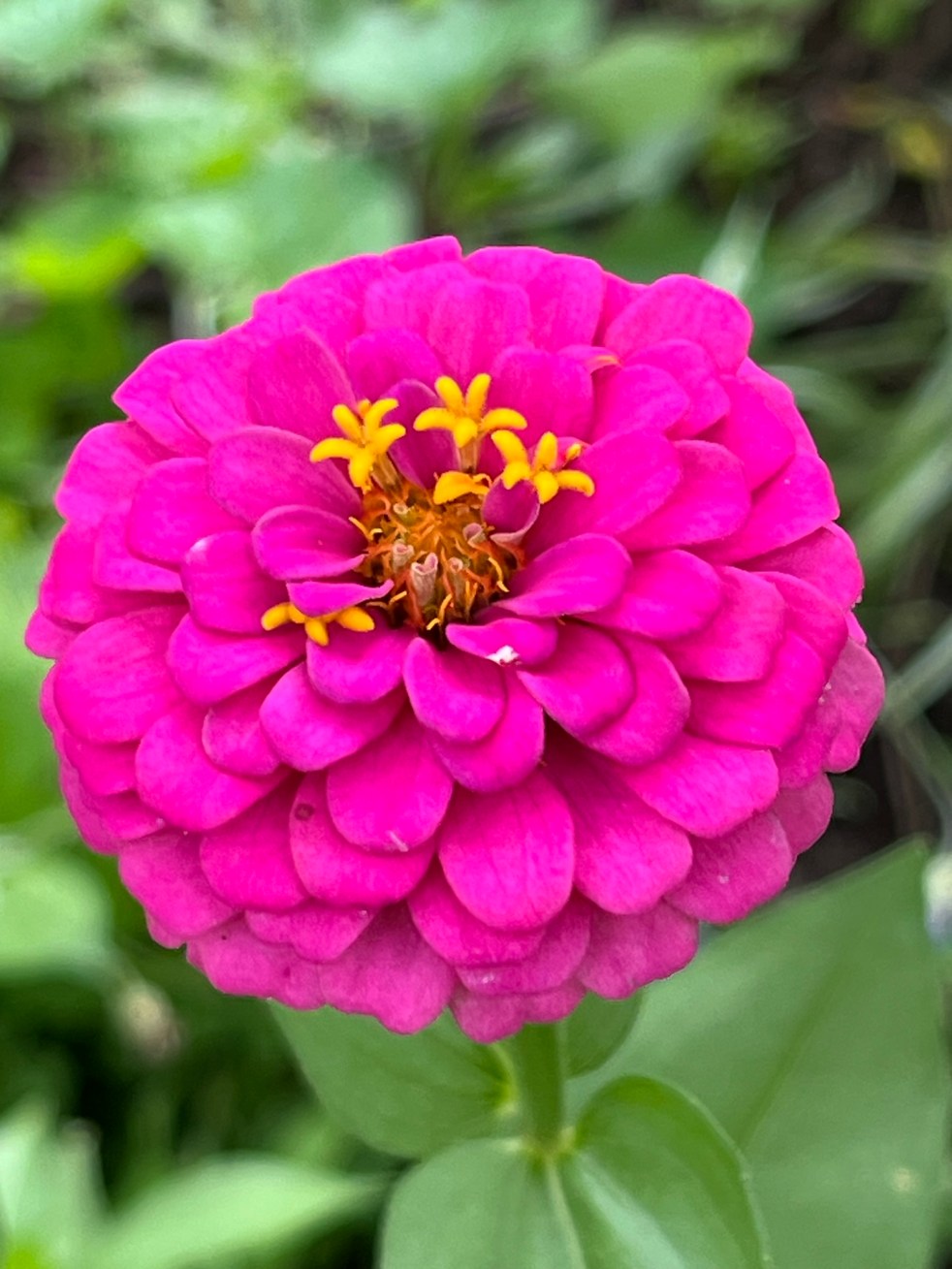
I’ve been taking photographs of flowers and trees and plants and bees…all spring and summer. Ma’am the squirrel makes an appearance in the video below. She’s got babies now and she stops by, but those babies take up a lot of her time. She’s fully healed, so it’s hard for me to tell if it’s her or not her. I ask all the squirrels if they are ma’am. I am pretty sure they think I am the strangest food lady ever.
Some sad news to report on ERJ (my eastern redbud tree, for those who are new here. He and William The First, my Willow Oak, are tied for favorite tree first place): I noticed he wasn’t doing well a couple months ago and had an arborist come look at him. He has borers. The arborist seemed to think ERJ would pull through, but I have serious doubts. I know my tree, and he doesn’t look well. His leaves are yellowing and dropping. He has tons of suckers and tons of seed pods. I feel like this is his last hurrah trying to create new generations. I have applied the insecticide three times now and I don’t think it’s working. You might remember ERJ from previous posts. I will be very sad to lose him, but at the end of this video, you will see I have another redbud in my backyard and its leaves are huge. I love the heart shape of the leaves. It’s truly my favorite type of tree. But don’t tell William.
I hope you enjoy this trip around my flowers, an (unnamed) eastern redbud, a lightning bug, a bumblebee and a squirrel.
AKA Lightning Bugs, these precious creatures are dwindling in numbers. Pesticide use, along with light pollution – i.e. bright lights alongside of your house, in your yard, and in your neighborhood, as well as more urban area lighting in general are contributing factors in the decline in numbers that we are seeing.
I used to see hundreds of them in my backyard every summer starting in June. Seeing them is a staple of summer. Seeing them is a marker that summer is here. Seeing less of them each year is concerning.
I went on a quest this morning to see if there was an organization or any way that I can contribute to slowing the progression of possible extinction of these beetles – the projection is 20 years and they will be no more. I can’t imagine a world without lightning bugs.
I found an organization that collects scientific data on fireflies, and the best part is that we can all contribute. It’s science and it’s fun!
The organization is called Firefly Atlas, and, well, that’s pretty much what it is.
The Firefly Atlas is a collaborative effort to better understand and conserve the diversity of fireflies in North America. Launched in 2022, the project aims to advance our collective understanding of firefly species’ distributions, phenology, and habitat associations, as well as to identify threats to their populations.
Although the Atlas tracks all species described from the US and Canada, we are currently prioritizing efforts for a subset of 13 threatened and data deficient species found in three focal regions of the US: the Mid-Atlantic, Southeast, and Southwest. These priority regions were chosen based upon having a high number of threatened species (Fig 1) and/or a high number of data deficient species (Fig 2).
Identify the fireflies in your photos, with the potential for verification by experts;
Download a species checklist for your state or province of interest;
Learn more about fireflies, their ecology, and ongoing conservation efforts;
Help researchers better understand the distribution of fireflies; and
Connect with other researchers, land managers, and community scientists.
Whether you already keep records of firefly observations, work as a conservation professional, or are simply curious to learn more about the fireflies in your area, please consider joining our efforts!
Please follow this link and if you feel inspired, let the little scientist in you participate. If you are not able to participate, please consider donating to this organization that is collectively trying to save our beloved, luminescent-bootied summer creatures.
Hundreds of fireflies, you would not believe your eyes


 “It's Amy,” I said.