

In mid- December of last year I finally got to the neurosurgeon’s office after months of trying to make the appointment. I kept having to reschedule due to scheduling conflicts. I wanted to see the surgeon about potential interventions for my unbearable neck pain of many years. I had tried physical therapy to no avail, and had two injections of steroids into C6. Everything seemed to make the pain worse, so my last resort was visiting the neurosurgeon. The pain is debilitating at times, with the nighttime being the worst. My other nearly debilitating symptoms include vertigo and dizziness, and a general feeling of being off-balance. It is exhausting to keep myself upright all day. And it is very painful in my neck region at night, so I’m not sleeping very well. Needless to say, I wanted answers and help. 
I had nothing to fear as I waited for the doctor to enter the room and review my cervical spine MRI imaging from June 2025. I had no reason to think anything would go awry because I had read the report and it didn’t seem very much changed from my previous cervical spine MRI done in 2020. For some reason, an MRI can look almost normal and a person can have severe symptoms, or conversely, the MRI can look like a train wreck and the person can feel fine. I would prefer the second option, but that’s not how I roll. 
So when the doctor entered the room, and after the pleasantries and introductions were made, he told me he didn’t see much wrong with my cervical spine. Sure, small herniations, and a little bit of a bulging here and there, but nothing warranting surgical intervention. “But, there is something I want to show you. Something else.”
I could feel the frown forming on my face, and the slight anxiety building in my chest. The doctor asked me to pull my chair over to look at the image on the screen, which was of course my cervical spine and the bottom portion of my skull and brain. “See this? This is your cerebellum. The cerebellar tonsils are hanging down through the opening at the base of your skull and into C1. You have a size ten skull and a size twelve brain.”
“I beg your finest pardon?” I asked in a statement. I was stunned and nearly speechless, but I think he just said I had a big brain, so there’s that.
“You were born with this congenital condition that is known as Type I Chiari Malformation. I believe all of your symptoms are caused from this malformation. Your brain is constricted and requires decompression. Your symptoms of dizziness, migraines, gait imbalance, limb numbness, and various others are caused by this compression. Cerebral spinal fluid can also be cut off leading to problems for the brain. The fix for this is a craniotomy to remove a piece of the skull as well as a laminectomy for C1 so that the brain hanging down has more space. After we remove those pieces, we put a band that we take from your hip and place it on each side of the skull so that the brain rests on that.”
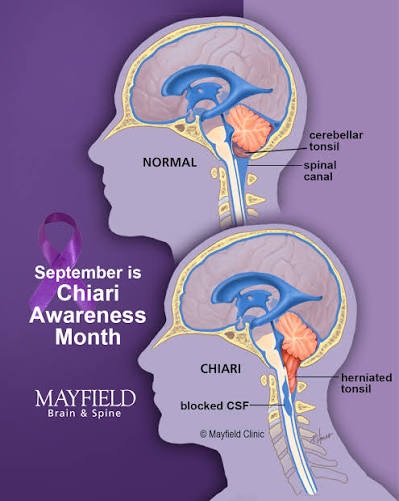
I really don’t remember thinking anything other than How did we get down this road? How are all of my symptoms being caused by my brain sagging with droopy drawers out of the base of my skull into my spinal canal? How is the treatment for this a craniotomy and a laminectomy? Why is my brain too big for my skull? Who even has this?! Not very many people, I can tell you that. In fact, I know of one other person who has this, and that person didn’t know anyone who had it either.
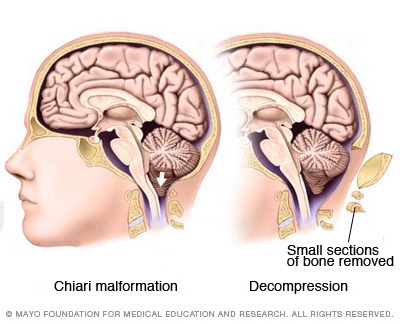
Switching tracks for a moment, I was scheduled for a brain MRI to look for an acoustic neuroma which my ENT suspected, since I suddenly lost a lot of hearing in my left ear a few years ago. But now I needed the brain MRI to confirm the Chiari Malformation. And then I got thinking: why did no one mention this on my cervical MRI report from 2020? This was when I first developed symptoms. And why did no one mention this on the cervical MRI report from June 2025? The neurosurgeon said it’s very common for them not to mention it. And, in fact, when I did finally get the brain MRI at the end of December, the malformation was yet again not reported. And because they neglected to perform sagittal views on that study, the doctor couldn’t confirm the diagnosis. I then had to get another MRI of my brain which did confirm my diagnosis.
I recently returned to discuss options and the game plan. I’ve had several months to research success stories and not so successful stories as a result of decompression surgery. I’ve also been instructed by a trusted source to get a second opinion. When I returned to the surgeon’s office, he said the surgery is not an emergency. I could schedule it in five years or I don’t ever have to do it. My CSF is not being blocked off, so my brain is receiving the nutrients that it needs. I don’t have something called a syrinx, which is a cyst that forms in the spinal canal as a result of this malformation. Seven millimeters of my cerebellum is hanging down and makes itself known, however. Migraines, dizziness, vertigo, pain up the back of my head and down my shoulders, a constant feeling of being pulled and off-balance when I walk, extreme fatigue at the end of the night, vertigo when I tilt my head back, and the inability to lie on my back because my brain is essentially right under my skin and feels compressed in certain positions – these are all symptoms I deal with on a daily basis. And for now, I will continue dealing with them. I like my skull pieces where they are, and I do not want to remove the first vertebrae of my spinal cord. I have no restrictions other than if it hurts don’t do it. Well, I’m not allowed to ride roller coasters but that’s not a problem for me because I don’t like them anyway. But doing nothing carries its own set of consequences: I will still have these symptoms and I will need to manage them the best I can, but it is incredibly fatiguing. I’m going to seek a second opinion at a university hospital in a large city. Perhaps there are other options for me to get my brain decompressed and relieve my symptoms. I don’t want to continue to live on the struggle bus, but I don’t feel comfortable removing a large section of my skull and my first vertebrae. It’s my personal belief that because I’ve had this since I was forming in utero, my body has adapted to this condition. It’s not perfect, and in fact, it’s really rather terrible at times, but what happens when you start removing pieces of your body? What happens when you remove the stability the body has always known? I’m not fully convinced that in the case of an elective surgery, this is the best route at this time. My skull may be too small for my brain, but it’s still my skull. It protects my brain. And the first vertebrae of my spinal cord is important. Every vertebrae underneath of it is important. They all rely on the first one for stability. I have concerns.
The first few days of receiving this diagnosis had me in a state of shock. I’m still not sure which parent to blame for my big brain and tiny skull. So I looked at the sky and I squinted my accusatory eyes at both of them. Also, within the first few days of this diagnosis, I nicknamed the malformation Kyrie. I made up a little song based on that 80s song by Mr. Mister – Kyrie eleison. I pulled these lyrics from the song.
Kyrie eleison down the road that I must travel
Kyrie eleison through the darkness of the night
Kyrie eleison where I’m going, will you follow?
Kyrie eleison on a highway in the night
And this is how I altered them:
Kyrie lays on the top of my spine
Kyrie lays on C1
Kyrie lays on and will always fall down
Kyrie lays on my neck all through the night
As for me and Kyrie, we will be getting a second opinion in the coming months. And in the meantime, I will try to educate people about this rare condition. It’s been a long journey to get answers for my migraines and all of these other weird symptoms. Let me know in the comments if you or anyone you know has a Chiari Malformation.
(Sorry guys, I tried to embed the video for Kyrie eleison by Mr. Mister, but WordPress is not allowing it. Kyrie original lyrics ©️ Mr. Mister)
©️2026, itsamyisaid.com, all rights reserved
 “It's Amy,” I said.