Born on December 18, 1775.
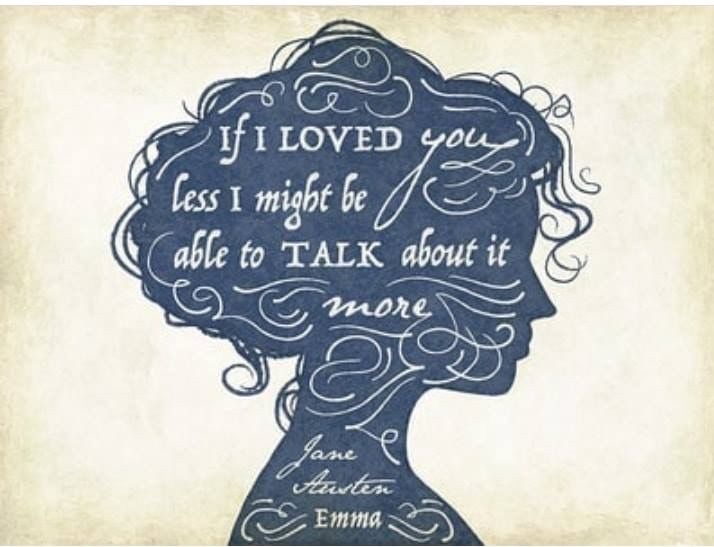
What is your favorite Jane Austen novel?

Born on December 18, 1775.
What is your favorite Jane Austen novel?
What positive events have taken place in your life over the past year?
Waded through the grief
Bandaged the broken heart (it still seeps)
Plodded through the dashed dreams
Said a prayer for the lost (souls, loves, hopes)
Sighed, inhaled
Felt a tiny spark
Of what came before
What came after
Remembered my strength
Found the Muse
Re-bandaged the heart
Put pen to hand
Returned to Self
©️2023 itsamyisaid.com, All Rights Reserved.
©Amy J. Bates, 2006, 2023
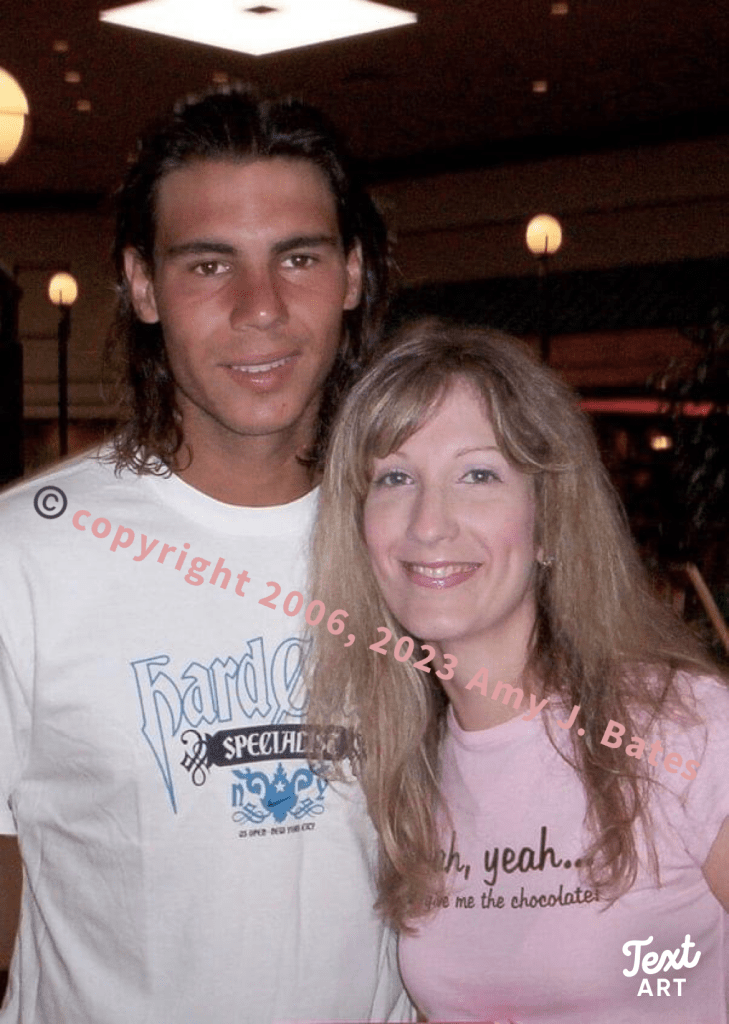
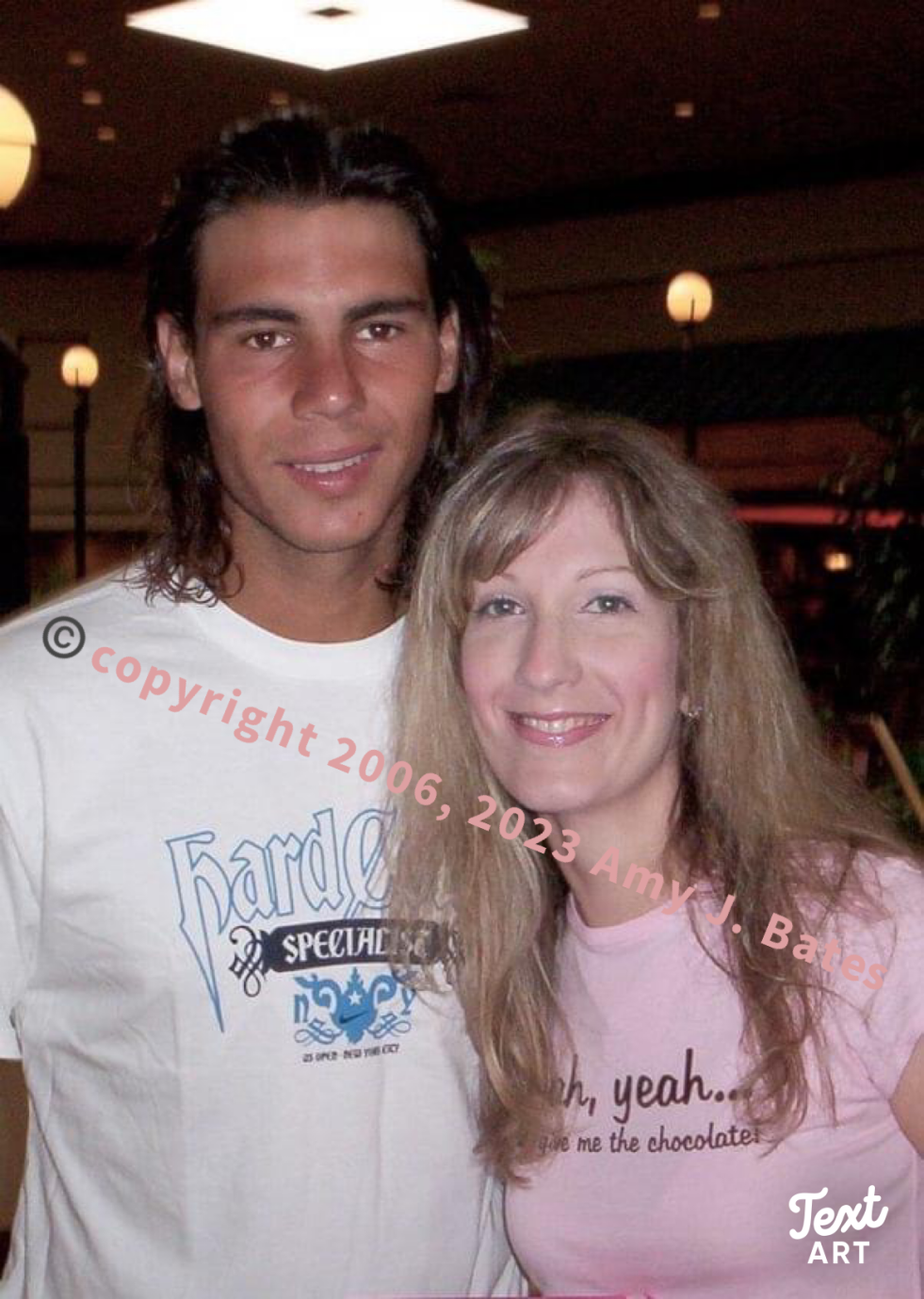
As tennis fans celebrate the return of Rafael Nadal to the game in 2024, for what is expected to be his final season, we look back to the year 2006. Rafael Nadal was ranked Number 2 in the world, and had just turned 20 years old two months’ prior. Rafael joined me for an informal interview over breakfast in the restaurant of a hotel in Mason, Ohio, home of the Cincinnati Masters (as it was known at that time).
Many thanks to Rafael Nadal for this interview, and I wish him well in the next phase of his life.
Thursday, August 17, 2006, 9:20AM
This morning I had breakfast with Rafa. Well, he had breakfast, I had water. Originally, we had planned to do a brief question and answer session last night in the atrium of the hotel where we are both staying here in Mason, Ohio, but plans got a bit muddled and a new time of 9:20 a.m. was established.
I arrive at the atrium at the designated time, with my pink notebook, digital camera and Micro RC Racer pen in tote (I demonstrated my mini race car pen for Rafa later. “Yes, I see your car pen,” he humored me.) Minutes later, Rafa ambles down the hall, lugging with him a large cardboard box and chatting on the phone. He points in the general direction of the restaurant, indicating I should follow.
My short legs struggle to keep up with his long strides, but we make it. We are seated at a table near the front and Rafa takes off for the buffet. I sip my water the waitress brings and wait patiently, a bit nervous because I’ve never interviewed anyone before. Rafa arrives with a box of Frosted Flakes and is no longer on the phone. The waitress returns to take Rafa’s beverage order and he surprises me with his answer: hot chocolate. “Funny!” I tell him.
“Read my shirt!” (The print of my shirt reads Yeah, yeah…just give me the chocolate!) “I saw that,” he smiled and laughed. The waitress returns with the hot chocolate and there is no whipped cream. I frown. “You can’t have hot chocolate without whipped cream…” Rafa agrees and asks nicely for some whipped cream. Following Rafa’s consumption of the now melted whipped cream, he then proceeds to pour the entire contents of his Frosted Flakes box into his hot chocolate.
I do a mild shift in my chair. “That’s interesting…” I say. Rafa assures me it is done like this in Spain all the time. The only difference, he says, is that the hot chocolate is made with milk, not with water. We both agree that would taste much better. I’ll have to try the Frosted Flakes/hot chocolate combination when I really need a sugar rush. As Rafa eats his breakfast, the “real” questions begin.
“Do you like this tournament? Do you feel this tournament is helpful to your preparation for the US Open?” Rafa nods, “Yes, I am happy here. I did not play that well in Toronto. My goal is to play well in the US Open.” He mentions to me later on that he has been practicing three and a half hours each day since before this Cincinnati tournament began. I then ask him what his favorite tournament is. He tells me he likes many of them and can’t choose just one. Just about that time, the first fan comes up for an autograph and Rafa diligently signs. “Does it bother you when people ask you for your autograph when you are eating?” I ask. He shakes off my question. “No, it does not. It does not bother me.” Next question: “What’s the weirdest thing a fan has ever given you?” He does not understand me, so he enlists the table of Spanish-speaking men next to ours for help.
The answer: “A rock.” I stare at him. “A rock. Somebody gave you a rock.” One of the men at the table piped up to Rafa, “A rock, just like you.” They all laughed. Rafa let out a small chuckle. He didn’t understand my next question either, and I felt badly that I didn’t know enough Spanish to help him. (My goal: learn Spanish for next time.) But it was an important one, I thought, so again, our friendly neighbors assist. “I want to know what makes him laugh. What kinds of things does he find funny?” Rafa responds, “A lot of different things.” I think he said he likes to laugh and I gave him the universal thumbs-up sign for that response.
“So, when you win a tournament, is it the same feeling each time, or is it just a bit different?” Still munching on his Frosted Flakes concoction, he says, “No, no, it is not always the same feeling each time.” And that was that. “Rafa, this is my first visit to this tournament and I notice sometimes it can be…well…a bit boring when there is no tennis to watch. What do you do for fun during tournaments?” Rafa replies, “I have my computer, I play golf…” I ask if he will go to King’s Island Amusement Park.
He scoffs a bit. “Oh, well, maybe if I lose I will go there.” Cleary his mind is on work, not play. My last question before the interview ended was a bit odd, apparently. “Rafa, can you wiggle your ears?” He stared at me blankly. I lifted my hair to demonstrate. Wiggle, wiggle.
He looked down to his cereal, almost disturbed, and clearly flustered. “No, no, I cannot do that.” Oops. I hope I haven’t violated some kind of ear conduct code. Sorry, Rafa! Then the interviewee asks the interviewer some questions. “Where do you live?” he asks. “About nine hours from here, in a place that looks very much like this place – boring! And here I travel all this way to end up in a place that looks like my home.”
He seemed sympathetic. He lives in Mallorca – he should be sympathetic. He is also sympathetic of my severe sunburn, telling me, “Well, it’s hot…” It’s getting close to the time when Rafa needs to leave for practice. One more fan walks up to the table and Rafa grapples with spelling out personalized autographs using English names for the letters.
He perseveres and gets it right. Rafa asks for the check, signs for it and we’re off. A hotel staff member takes a photo of Rafa and me (I poke him in the back and whisper for him to smile – he does), and he says, “Okay, Amy, see you soon,” or something to that effect. He was already on the move, eager to work off those Frosted Flakes on court, I’ll bet.
©2006, 2023 Amy J. Bates, itsamyisaid.com. All rights reserved. No part of this interview and/or photograph may be reproduced in any manner whatsoever without written permission of Amy J. Bates.
If you’re a tennis fan, you know that Rafael Nadal has been sidelined by injury for the past year.
Today, December 1, 2023, Rafael made the announcement that he will be returning to Brisbane, ahead of the 2024 Australian Open. Anyone who has followed Rafa on social media knows that he has been working hard to come back for one more year before retiring from tennis on his own terms. It’s not a secret that he – and most tennis fans everywhere – knows this is his final year on the pro tour. At 37 years of age, his body has essentially decided that it’s time to do other things. Rafa turned pro at the age of 14, which is a lot of mileage on a body. But, as one would expect from someone of Rafa’s ilk, he’s making one final push to achieve more. On his terms. I don’t blame him, I wouldn’t want to be forced out of my life’s calling, either.
I first became aware of Rafa Nadal during the Davis Cup competition when Rafa was 16 years old. I sat in my chair in my living room and stared in amazement at my television screen. I’ve been a tennis fan since I was 15 (which was 137 years ago), so I know when I see burgeoning greatness. But with Nadal, the greatness was already evident, the burgeoning had already happened, somewhere, somehow, without anyone seeing.
Since then, I have attended several tournaments where I have seen Rafael practice and play – there is a little distinction between the two, the ball is struck just as hard for a seemingly unrelenting amount of time. The quickness Rafa displayed, especially early in his career, was a marvel to witness. The sheer size of a tennis court doesn’t translate on a television. Sitting courtside, you become more aware, and standing on a court with a racket in your hands, you are painfully aware of the ground you must cover, but I digress. And I may be projecting, so please forgive me. I’m not able to chase down all the balls, but Rafael Nadal is otherworldly. He arrives to the court to battle. To chase every ball down, to attempt to hit every shot. When the score line reflects the opponent is winning, he still fights. The belief never leaves him. Never.
As I mentioned, I have attended several tournaments and have seen Rafa play firsthand. A most fortunate occasion occurred in 2006 at the Cincinnati Masters (as it was called then). I was given the opportunity to interview Rafa Nadal. He is intelligent, humble, funny, clumsy, and gracious. He has the heart of a warrior and his body that is now battle-proven (forget about tested – been there, done that) – is testament to his warrior spirit. But in 2006, Rafael Nadal was a youthful 20 years old, was not yet fluent in English, and I couldn’t speak much Spanish. More on that later.
I’ll leave you with this, for now. If you’ve ever shaken a professional tennis player’s hand, you’ll immediately notice the calluses. The blisters. The evidence of how hard they work every single day is just at your own perhaps smooth fingertips. The feel of hand of a warrior is a bit alarming. At the same time, as a tennis fan and as a less-than-mediocre tennis player myself, the feel of a hand of a warrior is exhilarating. To be able to sense with your own touch the mind, body and soul that goes into being a professional athlete is awe-inspiring.
I’m still in awe, but not about the calluses. I’m in awe at how long and successful a career Rafael has had, and how fortunate I have been to see it evolve. I am in awe of how time flies without realizing it even does. In his final year on the ATP tour, and in all endeavors to follow, I wish Rafael the very best.
In the next few days, I will be posting the interview that I conducted with Rafa back in 2006. It will be my contribution to the celebration of Rafa’s hugely successful tennis career. I’ll take you back to the beginning, as we look now to the end, with a smile on my face, and yes, a few tears. ¡Vamos, Rafa!

©️2023 Amy J. Bates, itsamyisaid.com, All Rights Reserved.
What are your feelings about eating meat?
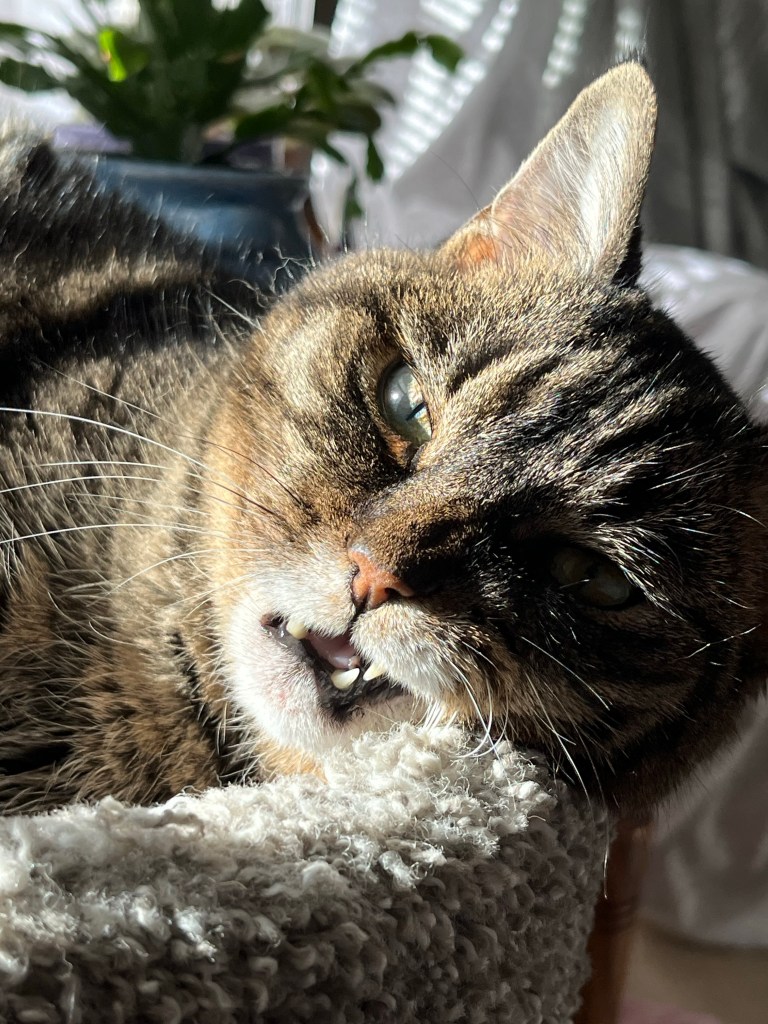
I think she did. I’ve told her to stay off the laptop numerous times. Usually she types something like, “bfnthrhfbdvrkihgdbd,” but I see this time she’s given it some thought
Well, it looks like she’s conducting a poll, and will be utilizing this information to convince me to buy the larger size of beef treats.
(She doesn’t know I bought the large bag of chicken-flavored treats, so I hope you understand that your answer to the question will be recorded and used at a later date.)
©️2023 itsamyisaid.com, All Rights Reserved.
He’s a bit singed around the edges
Eyes like burnt Tennessee whiskey too
His cloak of black
Matches his soul
He’s destructive, destruction, deconstruction
You know the deal
He might have been the devil himself
Yet all I could see
Then
Was how well his scarlet skin
Contrasted with his fine black cape.
©️2023 itsamyisaid.com, All Rights Reserved.
Name your top three pet peeves.
I used to have more than a handful of pet peeves. But over time, and most likely since the passing of my mother three years ago, combined with the daymare that was the pandemic, and so many changes overall within and without, my pet peeves have dropped off significantly.
I wouldn’t say they’ve disappeared altogether. For example, people not returning shopping carts to the shopping cart bay, or to the front of the store is irritating, but it’s a small speck in the landscape. I’d rather return it to the bay or give it to an elderly person as I’m on my way back to the bay, than to stew about people not returning shopping carts.
I still notice when people ding my car with theirs and seemingly don’t care, but that really says more about them than it does about me. And it’s not something I can control. Thinking about things you can’t control is a waste of time. Others’ behaviors such as lying or cheating would still have the ability to overwhelmingly cause me to see red, but that is their behavior not mine. And it reflects on them not me. All I can do is not lie and not cheat and put my cart back in the bay and help the older person and shrug off the ding on my car. There are other things that I want to do with my days, and they don’t include throwing attention at things I cannot control. I believe that love and loss teach you what is important in life, and having experienced overwhelming loss of love and loss of the way life was at precisely the same moment in time, I can assure you from my standpoint, nothing else really matters. Let the peeves go, Jeeves.
There are many ways to acquire a muse, and just as many ways to lose one. I’ve gone long stretches of time without a muse, and it does impact my desire to write.
Muses don’t have to be external to one’s self, they can be a self driven motivation from deep within I suppose, but in my case, the muse is external to me. Whether it be a person, place or thing, my muse is not a part of my consciousness, or subconscious, for that matter.
I’ve been reading about famous writers and artists and how they’ve found their muses. In many of the cases, their muses are a person they know, and more often than not, a person they have a relationship with. But I’m going to go out on a limb here: a muse is only inspiring to me when the person, place, or thing is not part of my everyday life, or anyone that I have had a relationship with. Diving deeper, I realized I employ limerence to allow my muses entry into my thoughts.
Limerence is a hot topic on self-help social media due to it being regarded as a negative aspect of what the brain can do to deal with past trauma – and I am not claiming that it isn’t; as a sufferer of childhood trauma myself, I understand coping mechanisms and I am not here to belittle or in any way discount trauma, and how people cope with it. However, I know the difference between using limerence to gain creative inspiration versus limerence to replicate feelings of love. Limerence is not love, and love is not ever going to be limerence, and there’s no two ways about it.
But utilizing limerence to find and keep a muse? You’d be surprised how many creative ideas start to form. In fact, I believe if you get too close to your muse, you’ll actually lose the creative force that limerence offers. It is an idealized way of seeing someone and romanticizing that person (if your muse is a person, that is) in your life. The less I interact with the person, the better for my creative process.
I like to keep my muses as long as possible, because there are stretches of time where the Land of the Muses is a parched desert with tumbleweeds blowing all around and nothing but mirages for miles. Some interaction with the muse is helpful, otherwise, what can one use as inspiration? But too much of a good thing is not always a good thing. The more you get to know a muse personified, the more the gold shiny coat wears off and underneath it really is only nickel and it starts itching your ears and your neck and you’re allergic to it and you’ve got to throw it away.
I just recently realized that I use limerence to obtain my muses and it surprised my brain, which is confounding, because Brain is in charge of that stuff. Brain should be better organized, but Brain also uses sticky notes for everything, so…I get it. That said, even my tree, William, is a muse. He’s quiet, we don’t talk a lot, and he inspires me.
What works for you? How do you obtain a muse? Is your muse internal or external? How do you keep a muse and how do you lose a muse? Have you ever thought about limerence as it relates to letting a muse twirl around and be lazy and fabulous in your brain? Are your muses people, places, or things? How and when do they strike? It’s all so very a-musing, don’t you think?
©️2023, itsamyisaid.com, All Rights Reserved.
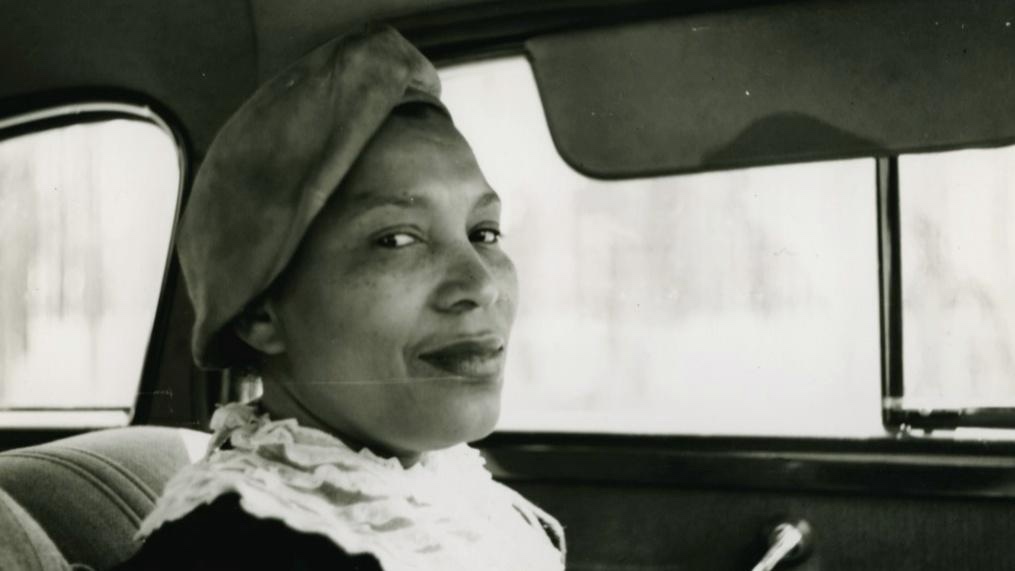
Zora Neale Hurston.
Who’s yours?
Name the most expensive personal item you’ve ever purchased (not your home or car).
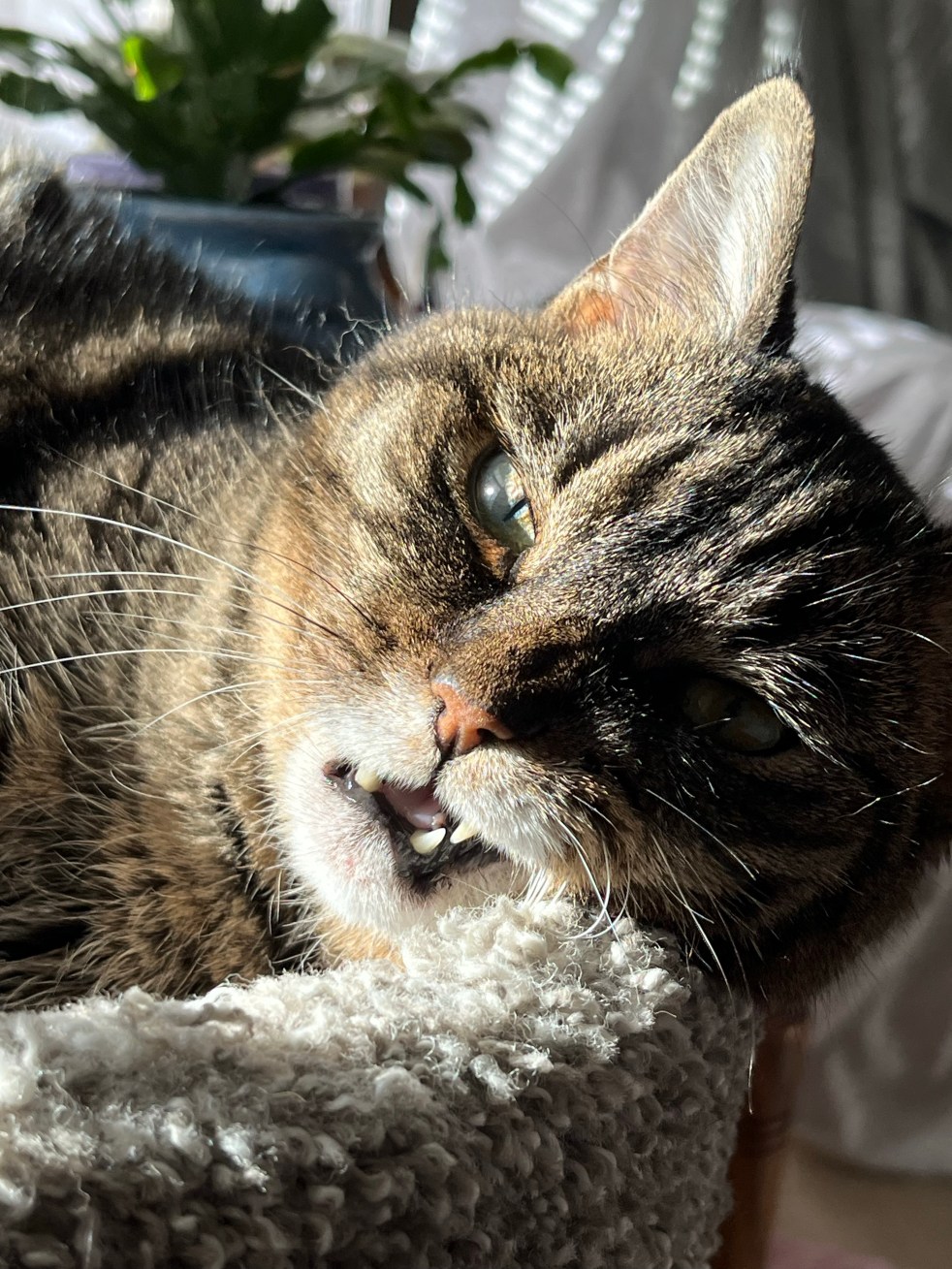
There is not one, and they are not bought. How one acquires cats is this: one shows up, and hours to months to years later, another one shows up. This repeats until you have between two and four or more cats at any given time.
Cats are not items. But cats require the purchase of many items such as food they will not eat and treats they selectively eat (if you get the wrong ones, they won’t eat them either). Cat toys are bought in the hundreds, only to be left alone in favor of scraps of paper that fall off of various items: shoelaces, plastic bottle caps, and various other waste materials. Expensive cat beds are left untouched in favor of tissue paper from discarded gift boxes, warm towels inadvertently left on a surface, and your own pants left carelessly on the chair.
The litter. The litter is so expensive that it often means going without at least two items of food for yourself per week to allow its purchase. And you must purchase it – it is not only irresponsible to let your cats outside, it is dangerous for the cats. There are a number of diseases they can pick up from other cats and other animals that live outside. Cats can become badly injured in cat fights and by human cars. But let’s get back to the litter: it’s not just the cost of the litter, it’s also the human labor that goes into maintaining the litter box. My current cat will not use clumping litter, so the human staff (me) must scoop the poop every day. It is one of my more glamorous roles in the household.
Other animals require similar amounts of expense, care and investment of time, but what other animal besides the cat expects these tasks to be performed without question? And yet, it is all worth it in the end, when the cat slow blinks at you and rubs their cheeks and tails against you in a sign of ownership and affection. They are telling you that they appreciate what you do for them, that they accept you no matter what you look like, or who you are, or what you’ve done in the past. (They are also telling you that you are not permitted to stop doing any of these things. Ever.)
The acquisition of cats is materially expensive, yes, but the unconditional love that is received from the feline in exchange is more than enough currency to pay for the acquisition of a cat.
©️2023 itsamyisaid.com, All Rights Reserved.