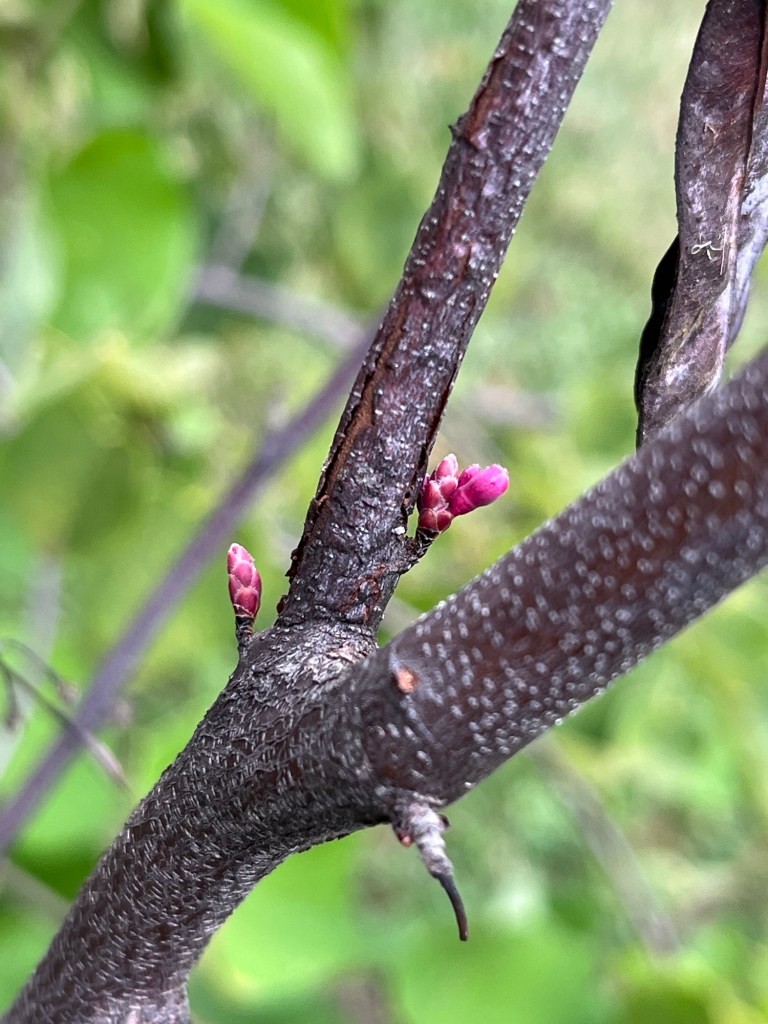
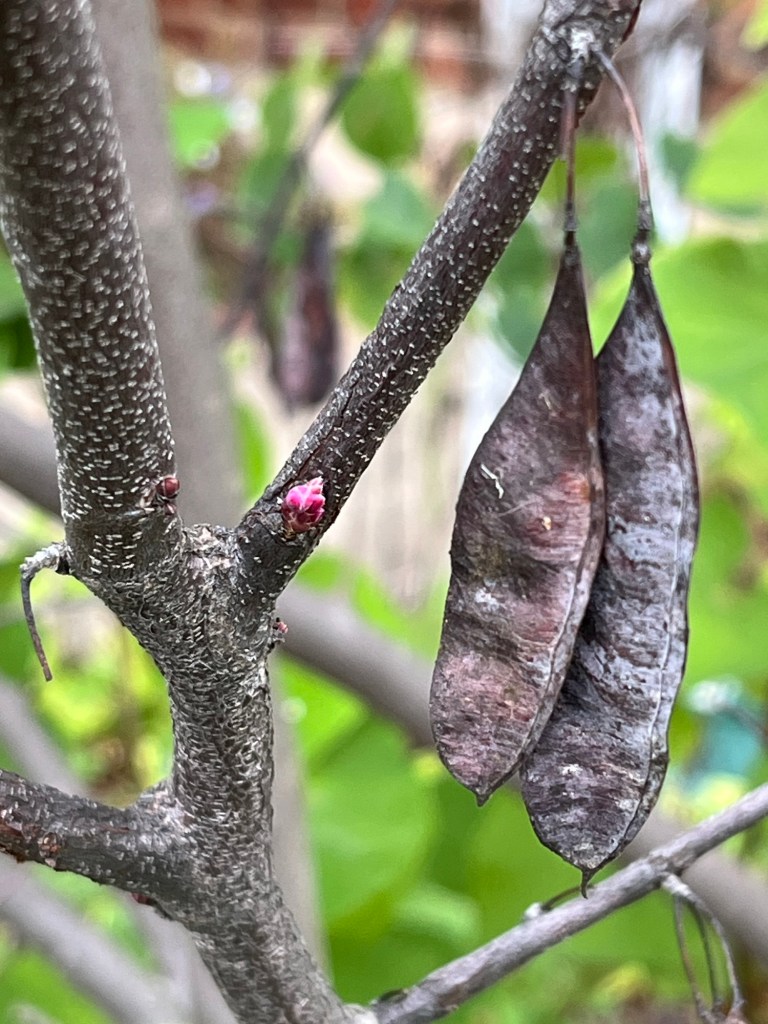
ERJ, my eastern redbud that I’ve written about multiple times on my blog, has been slowly dying all summer and now into the fall. Strangely, he had the most beautiful blooms this year he’s ever had. This past spring, I mean. He’s got borers. They did their damage. I tried everything, but I couldn’t save him. I knew I wouldn’t be able to, but I tried anyway. The loss of this tree really hurts. Some parts of his branches are still pliable, but most are brittle. The bark now splitting from lack of life. But I noticed today a bright spot of pink. And then another. Arising from the broken, cracked bark and perched alongside seedpods as brittle as dead leaves, ERJ blooms one last time.
ERJ – photo taken October 10, 2025 ERJ – photo taken October 10, 2025
Hey everyone! Popping in to share an update on that baby bird I found this past summer. As far as life goes, it’s been hectic. My new job is intense, the people are great and I love it. I have had no desire to write a single word, but I am enjoying this nice weather and all of the animals that visit every day.
I hope you all are doing well and I also hope to get bit by the writing bug again soon. Probably when things settle down a little bit (see what I did there?) at work. Until then, please enjoy the reappearance of Little Bit (and her friend, Plus One)! Apologies for the darkness of the video – it was hastily recorded through my window. Miss you guys! 🫶🏻
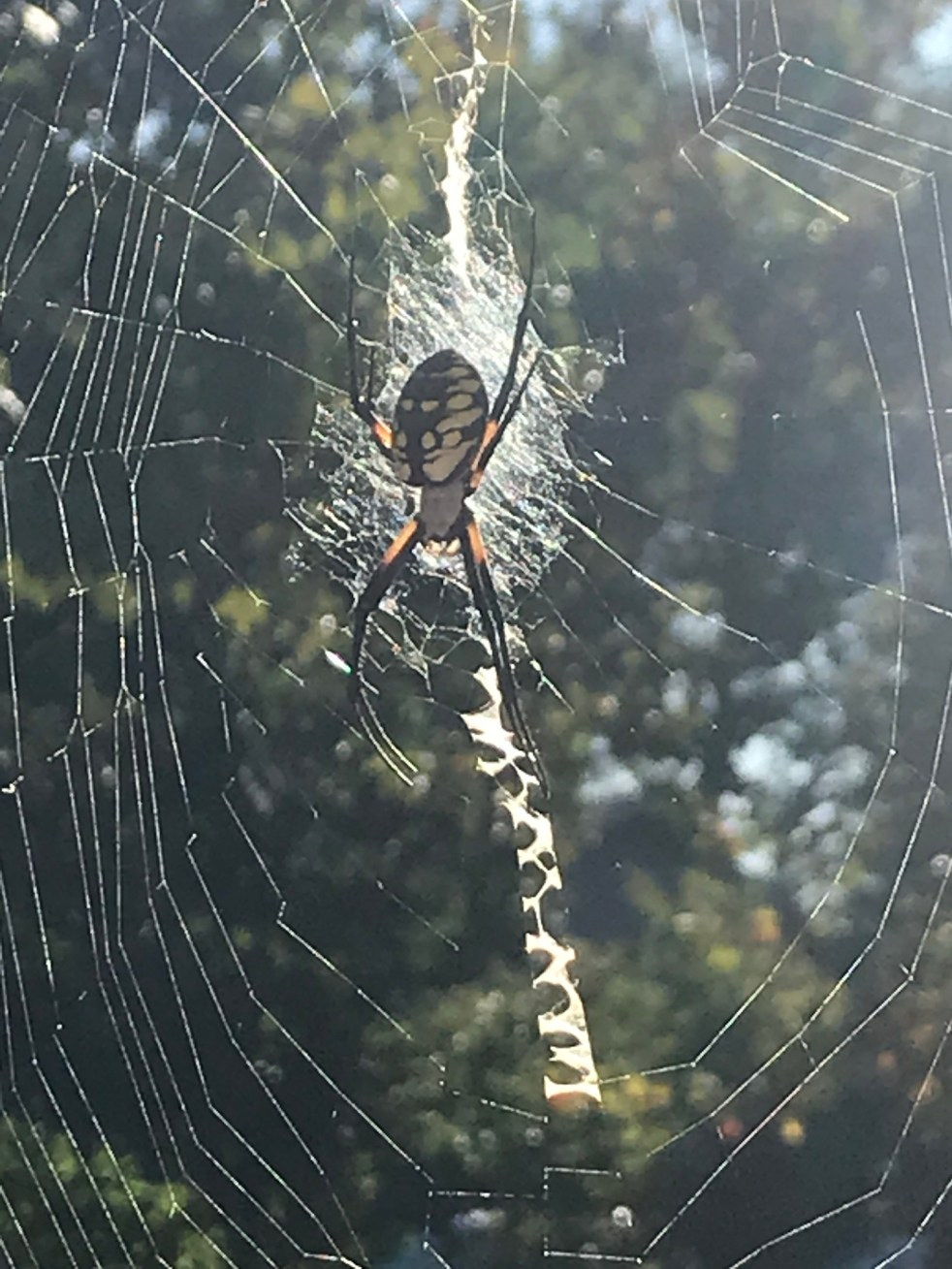
I shared this on Instagram today, and I’ve talked about Katherine a few times to fellow bloggers. I’m sharing the reel I made because maybe a few of you will be interested in seeing Katherine, an Orb Weaver that took up residence on my front porch a few years ago. She was majestic and fascinating. She laid two egg sacks in the clematis, which I promised her I would move to a safer spot once she was gone. She lived until mid December, which was quite a long time for a spider. I hope you enjoy the video. 🕸️🤍
There’s something about me you should know: I love trees. I believe the science that states trees communicate with each other through lengthy and entwined root systems deep underground, as well as through their branches and leaf canopies. Dying trees are fed sugar through their roots from other trees that know of their suffering. The forest is friendship and family.
But William, the towering Willow Oak adjacent to my home, does not live in a forest. Perhaps he started out in one, a hundred years ago, when he was a sapling – and before that, an acorn. But there’s no way to prove it.
As he is now, overseer of my home and its relatively small parcel of land, William has a few local friends. None are larger than he, but they are seemingly not intimated.
Oak trees are formidable, and they live long lives. William is an example of this – and yes, that’s his name, we have conferred. He asked for my name, of course. “It’s Amy,” I said.
Given his proximity to my dining room, health and sturdiness are important factors to know about William. “Great tree.” “Over one hundred years old. I’d love a tree like that on my property.” “Perfectly healthy.” Several tree specialists have said these exact words about my William. I imagine Wills puffing up and shaking his leaves in a show of bravado, but his leaves are eighty feet up and I can’t see what he’s doing with them.
And yes, I’ve decided William is a male. I’ve heard trees can be either/or, and William gives towering male protective vibes. He is over one hundred years old, after all. He’s a galant gentleman.
His trunk must measure fifteen to twenty feet in diameter (see photo above for William compared to the size of my foot). His visible root system grows just touching my house’s foundation – but before you become nervous about that, it just touches. The roots follow the line of the home in a parallel fashion, abutting, but never crossing. His well-established, strong roots running along the foundation of my home appears to be giving it a gentle but Herculean hug. He offers roots for when I feel rootless and ungrounded.
His rough bark reminds me that he is rough on the outside, but alive and doing important tree stuff on the inside. His green leaves of spring are a canopy of hope external (remembering that hope springs eternal), his brown leaves of fall are a yearly consternation to my home’s gutters, and are my shoes’ main nemesis. My welcome mat ignores the leaves completely, unfortunately. His acorns drop from up high, clanking the glass patio table. The acorns are large this year, which my mother always predicted meant a cold, snowy winter. We shall see. The squirrels have already begun to bury the acorns, and, if they remember the locations of burial, they will be well fed this winter.
When the invasive pest English Ivy threatened William’s trunk, I cut it away, furious. When it grew back and multiplied, I had it professionally removed. William seems pleased. He can show off his trunk again.
“It would take two hundred mile per hour winds to take down that tree,” a landscaper recently told me, staring up at William in awe. (He was the person who freed William of the ivy.) Fingers and limbs crossed that never happens. William is well-protected by my home in a sort of symbiotic relationship.
I woke this morning to see William in his usual place, with the sound of acorns dropping now and again. He seems peaceful and ready to get on with the cooler fall weather. He’s already preparing for spring. After visiting William, my mind and then my feet trailed to my front yard, where my surprise Eastern Redbud grows. Her name is Clementine, and she has a magnificent story to tell.





 “It's Amy,” I said.