
It all started yesterday morning when I was out watering the plants in the front yard. I water the plants every morning because it’s summer and it gets hot. If I don’t water, the hydrangea looks like it’s on its last legs by noon. To be honest, it looks like that throughout the day, and then I have to water it again, but that’s a different story.
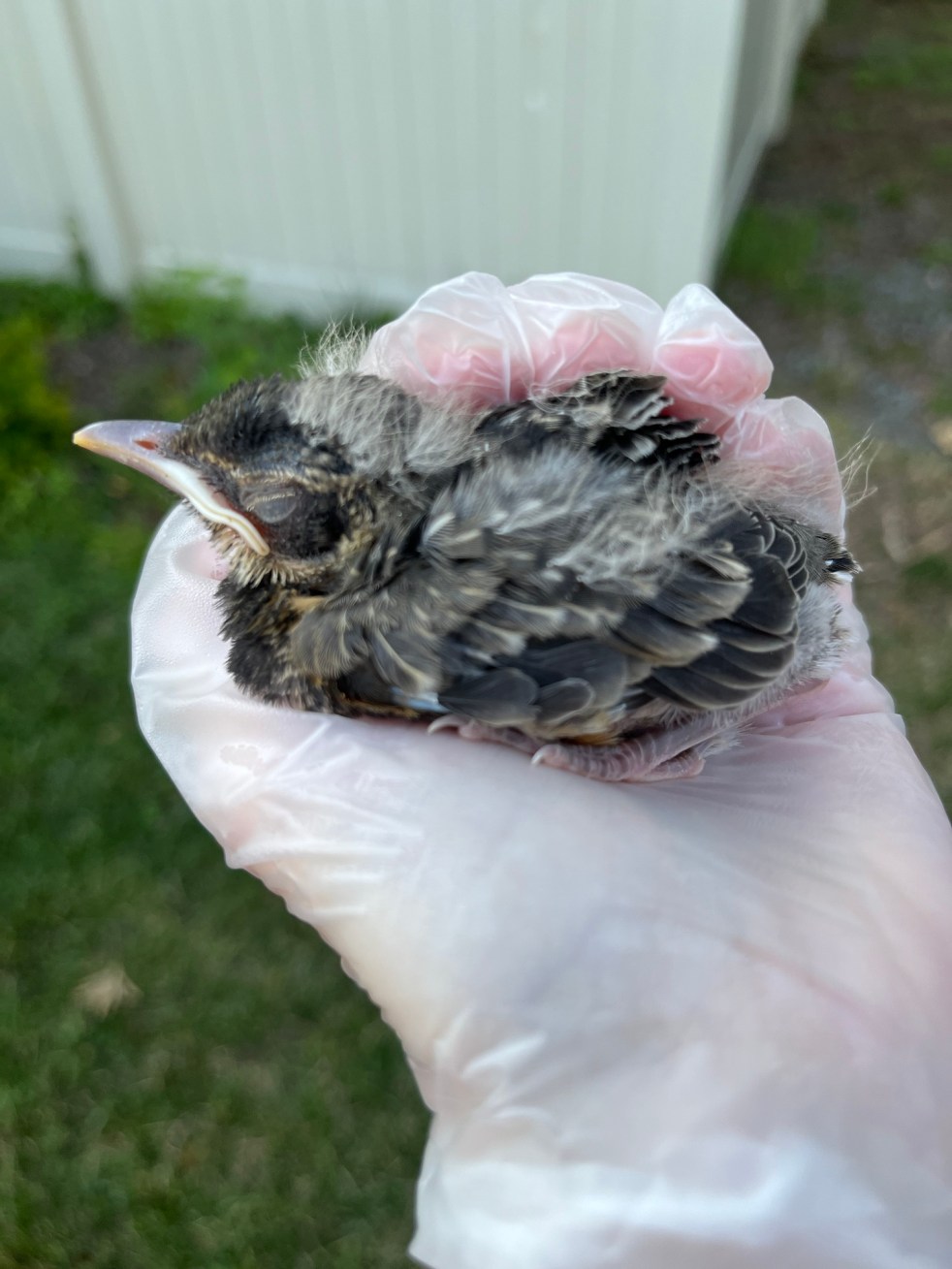
I was watering the plants per usual when I saw a tiny bird hopping in the grass toward the sidewalk and ultimately toward the road. As soon as I realized what was happening, I grabbed some vinyl gloves and hastily put them on as I hoped to reach the bird before she made it into the road. She did get to the road, but I got to her in time and scooped her up. Not sure what to do, I placed the bird – which I believed to be either an American Robin or a Bluejay – under my Eastern Redbud (ERJ, for those who have been here a while and are familiar with him).
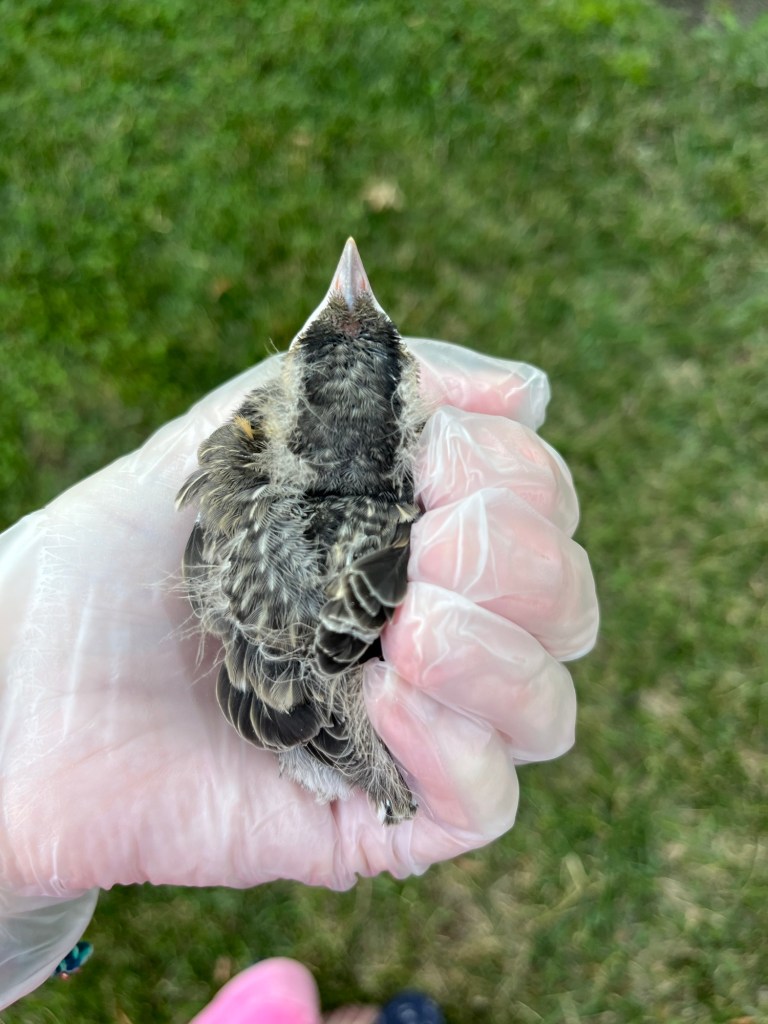
I went out to check on the bird midday and couldn’t find her anywhere. It was quite hot and I did a thorough sweep of the front and backyard. Twice. I couldn’t find her. An adult robin flew to the space under the tree where I had put the baby and chirped for about five minutes. I realized this was the baby’s mother, and she could not locate her baby. I tried once again to find the baby bird with no luck.
A few hours passed and I sat down to eat my dinner. I took a couple bites, looked out the window, and saw the baby hopping around near ERJ. I immediately swung into action, not even wiping my mouth nor realizing there was food in my hair. I put on some gloves, and flew out the door (no pun intended). I scooped up Little Bit (her new name) and my first thought was the mother left the baby after not being able to locate her earlier in the day. My second thought was not really a thought, but a perception. I formed a cup with both of my hands around this tiny little breathing warm baby with a tiny little rapid heartbeat and watched her fall asleep. It was in that moment I fell in love with Little Bit and was determined to save her.
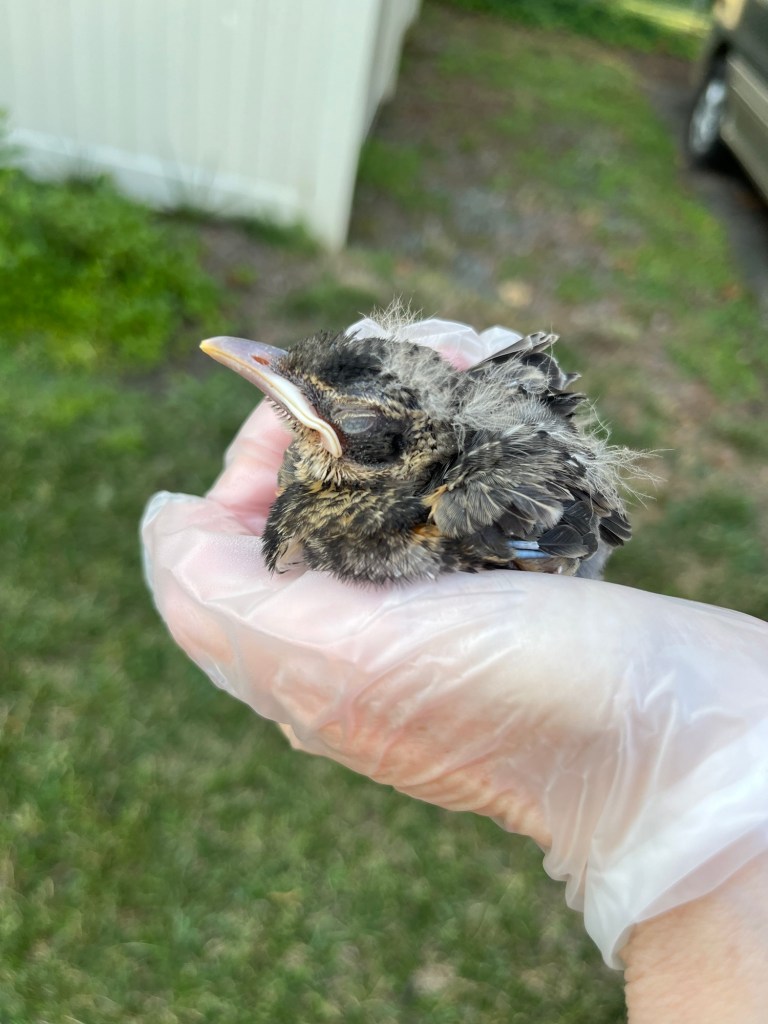
I was still in my bathrobe and slippers with food in my hair and with a face probably covered in food, when I walked over to a neighbor’s house and asked them to come look in the tree for a nest in another neighbor’s yard. I’m sure these guys thought I was a crazy bird lady and they’re not wrong, but they humored me. After about 10 minutes, they did find the remnants of a nest, but it was not inhabitable. By this time, my neighbor who lived in the house with the land that held the tree with the uninhabitable nest, came out and inquired about this activity. Her cat, who does sneak out and knows how to open doors, was very interested in the bird. (Don’t worry, she wasn’t able to get out.)
The men took their leave, unable to assist, though they did try. I still held Little Bit in both of my hands and she remained asleep. She liked when I pet her head. By this time, the mother robin realized I had the baby and was nearby chirping to it. Unfortunately, the baby was asleep. I wasn’t sure what would happen if if I removed one of my hands, but decided I needed to because I needed to consult Google ASAP. The bird sanctuary was closed and I had no other resources available to me to be able to figure out what to do with this baby bird.
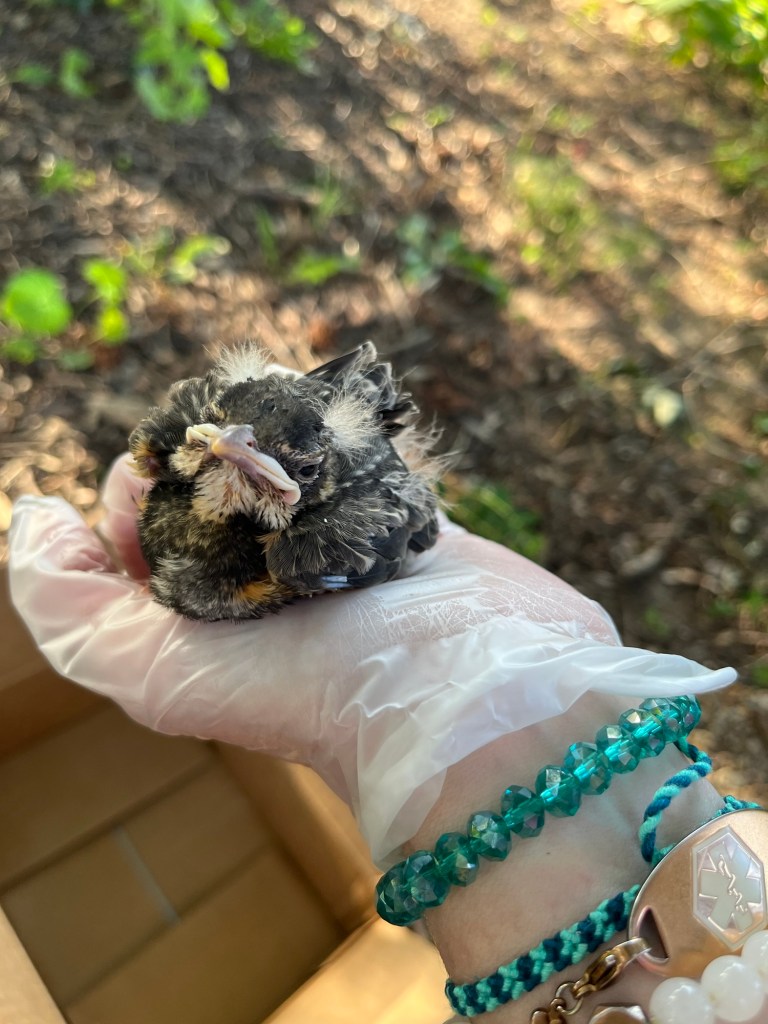
I walked around towards the backyard, hoping the mother would follow. She did, but I still didn’t know what to do. I took my hand away and was able to get into my phone. I Googled, “What do I do with a baby bird?” I found that if the bird can hop, it is a fledgling and it has been nudged out of the nest intentionally. In the fledgling stage, the mother puts the bird in a spot and stays nearby while it learns how to be a big grown-up bird. The problem with Little Bit was she didn’t stay where she was put. And she didn’t answer her mother when her mother called for her midday.
Armed with this information – thanks Google – I proceeded back to the front yard. I kneeled in the grass near ERJ and put my hand against the ground. I opened it up and waited for Little Bit to step out into the grass. The mother had returned and was waiting at the very top of the Weeping Cherry Tree. Little Bit jumped out of my hand and immediately proceeded to poop in the grass. Her mother was chirping to her, and had been for several minutes. Little Bit began chirping back and followed the sound of her mother. I removed my gloves and watched for a few more seconds until the baby bird got under the canopy of the tree and the mother came down to greet her. I went inside and thought how lovely it was to interact with a small creature so helpless and be able to offer her help by keeping her out of the road. I had been terribly depressed yesterday, and the distraction and the joy that bird gave me exponentially lifted my spirits.
I went out later to check on mother and baby, but couldn’t find either one of them. Google told me that the mother will find shelter and stay close by at night until the baby is ready to be on her own. So I no longer was worried about predators eating the baby at night. I assumed she would make it because I didn’t want to think about the alternative. I still don’t. 
I found out later I didn’t need to wear gloves when touching the baby, that it was not true that a bird will abandon a baby if it smells a human scent on the baby. They will not reject it. In my case, though, I am terribly allergic to birds and would have had to wear gloves anyway. I was experiencing a little bit of a wheeze while holding her, but I wasn’t about to let her go until I knew she would be OK.
This morning, I went out to water my plants – the hydrangea was already acting dramatic with limp leaves and sagging blooms and it wasn’t even 10 AM. It’s always high drama with the beautiful hydrangea. It’s the diva of the yard. I didn’t see a baby or a mother. At least not until I got the peanuts out and started dispersing them for the Morning Feeding. There is a robin who lives in the tree next door (the location of the uninhabitable nest), who comes every morning for a lovely peanut breakfast. Robins don’t normally eat peanuts, but this one enjoys them. She has been coming for months. I know it’s Little Bit’s mom.
Google told me that baby robins stay in the same general area as their nest once they’ve grown into adulthood. In fact, when their parents die, they will often take over the same nesting area. It also told me that robins are among the birds that recognize human faces.
I know when I said goodbye to Little Bit like an anxious auntie, that it wasn’t goodbye, it was see you later.
I know you’ll like the peanuts just as much as your mom. See you soon!
P.S. if you think I didn’t get cursed out in meow language by Susie when I came in the house at 7 PM you are wrong. Susie was extremely upset that I was outside playing with a baby bird and she was stuck in the house. Susie was born in this house and has never been outside, so I don’t know what her beef was, but she definitely was angry. I have never seen her so upset. I wanted to talk to her about it and I did ask, but she refused.
©️2024, itsamyisaid.com. All Rights Reserved.




 “It's Amy,” I said.